Solar access
Shade-free exposure during useful solar hours; orientation and tilt are confirmed at survey.

FPC installation · Patna
See the pre-installation checks, exact work sequence, commissioning tests, accessories and avoidable mistakes for flat-plate systems.
Shade-free exposure during useful solar hours; orientation and tilt are confirmed at survey.
Usable area, structural capacity, waterproofing, lifting route and safe maintenance clearance.
Hardness, TDS, chlorides and source determine direct/indirect loop and tank material.
Static/dynamic pressure, overhead head and pump supply determine valves and pressure class.
Eight-stage method
Survey daily litres, peak use, roof, shade, water and pressure.
Issue layout: collector rows, tank, pipe route, valves, access and structure.
Prepare anchored supports without compromising waterproofing; verify level and wind resistance.
Lift and mount collectors, preserving glass, frame and pipe connections.
Place tank and connect hot/return flow with unions, valves, vents, drain and relief path.
Insulate every exposed hot surface and weather-clad outdoor insulation.
Flush debris, fill gradually, purge air, pressure/leak test and prove safety devices.
Measure inlet/outlet/tank temperatures, verify circulation, document settings and train the user.
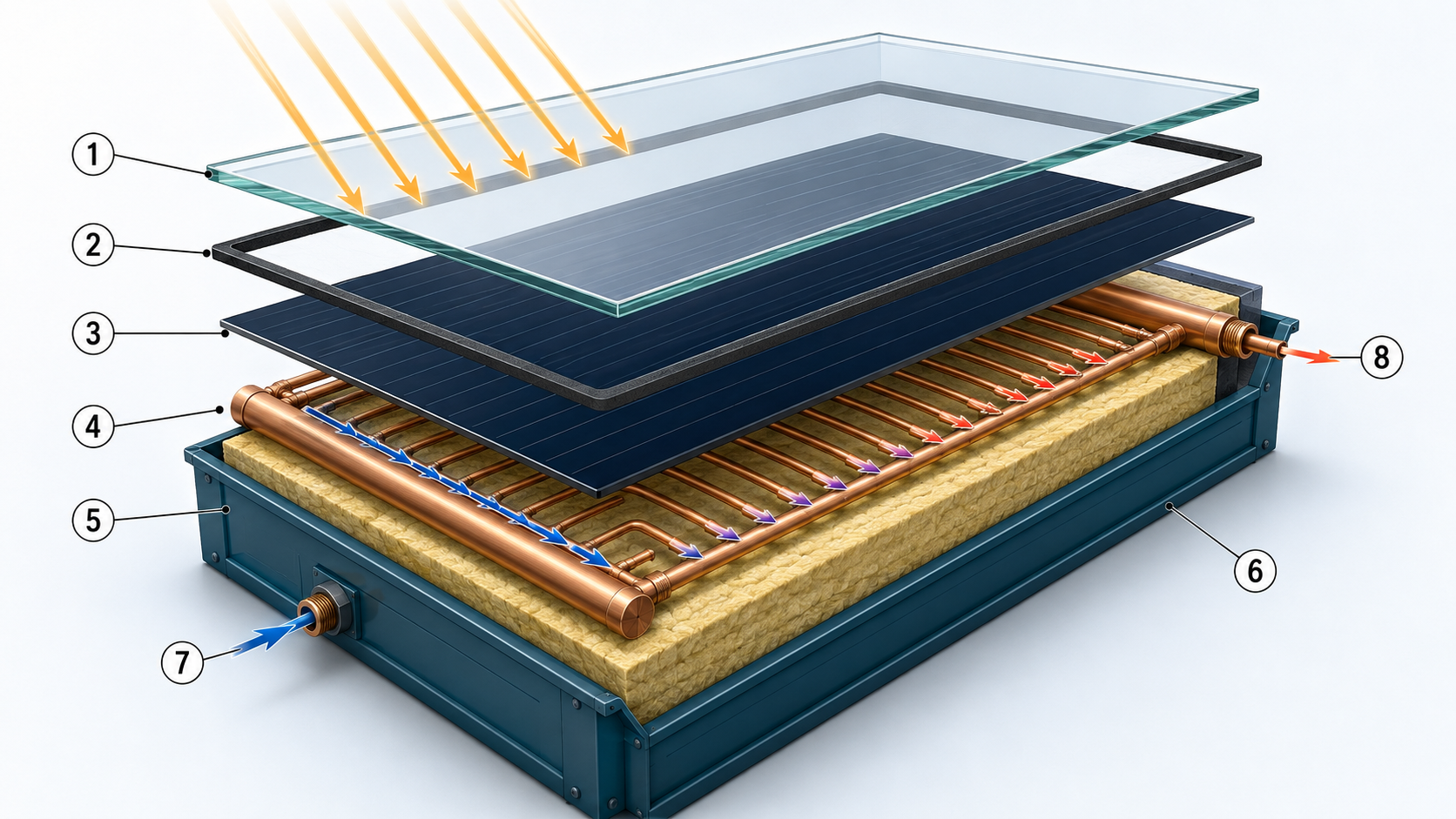
Conceptual educational cutaway—not a construction or manufacturer drawing.Admits short-wave sunlight and limits convective loss while protecting the absorber.
Keeps rain, dust and humid air away from the insulated collector box.
Dark metal surface absorbs high solar energy while limiting thermal re-radiation.
The lower header distributes cooler return through bonded risers; the upper header collects heated flow.
PUF or mineral wool slows conduction through the rear and sides.
Provides weather protection, mechanical support and mounting points.
Admits cooler tank/loop water to the lower header.
Carries collector-heated flow toward the tank or heat exchanger.
Avoid these failures
Domestic work may be completed within a day after the site is ready; institutional work depends on fabrication, lifting, civil readiness, hydraulic scope and safety clearances. Final timeline and price are issued only after survey.